microgpt
SourceA small GPT implementation and training pipeline in PyTorch, with a 124M model pretrained from scratch
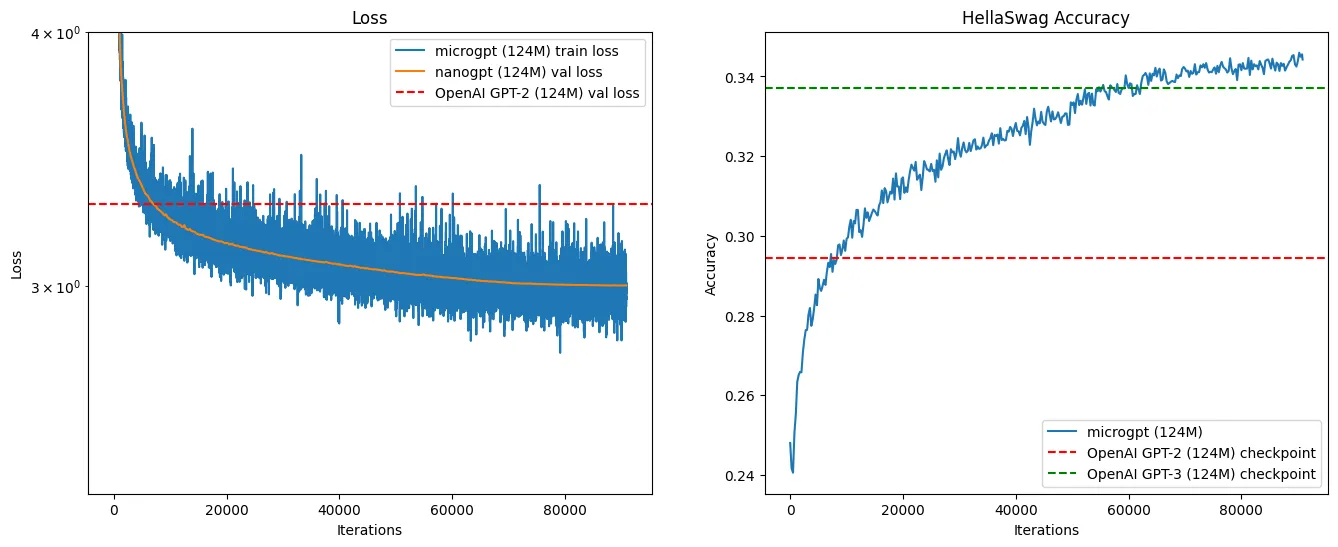
I pretrained a 124M-parameter GPT from scratch, and it peaked at 34.6% on HellaSwag, above OpenAI's GPT-2 (29.4%) and GPT-3 (33.7%) checkpoints of the same size. Training took about four hours on 8 H200 GPUs rented from RunPod at $32 an hour, about $128 in all.
Why build it
To learn attention, RoPE, multi-GPU training with checkpoints and two-stage training with weight averaging by building them. Post-training, mixture of experts and newer attention and normalisation variants were out of scope, since each adds cost.
How it works
The library has a byte-pair encoding tokeniser I trained myself, a GPT model with RoPE, data loading from text, files, URLs or Hugging Face datasets, multi-GPU training with PyTorch DDP and a HellaSwag eval. The model has 12 layers, 12 heads, a width of 768 and a context of 1,024 tokens, trained in two stages:
- A 10B-token sample of FineWeb-Edu, mostly web data
- Three separate runs on smaller, high-quality data from Cosmopedia and Alpaca, with their weights averaged into one model
Findings
The 34.6% peak came in stage 1, and the biggest lesson was data quality. Stage 1 saw about 48 billion tokens, against an estimated 100 billion for GPT-2 and 300 billion for GPT-3's model of the same size. FineWeb-Edu keeps only the web pages a classifier judged educational, and the FineWeb paper found it matched another open dataset's MMLU score with almost 10 times fewer tokens. HellaSwag also suits a model trained on plain English web text, which likely gave up skills it doesn't test, such as code.
A script in the repo downloads the model and tokeniser, and the notebooks walk through them and the training charts. The project builds on Andrej Karpathy's Neural Networks: Zero to Hero, minbpe and nanoGPT.